The Service End...
Search
Syndication
Friday
Jan272012

They Do Not Drink, They Guzzle

    O would some power the giftie gie us to see ourselves as others see us.
    (O would some power the gift to give us to see ourselves as others see us.)
        Robert Burns, Poem "To a Louse" - verse 8
        Scottish national poet (1759 - 1796)

This is a break with schedule to offer the following.

This is a quote from the travel log of what passed at the time as an educated person with an ability to relate, through a journal, their very personal reactions to what they found on their travels. It is something of a genre...

That said, I offer the following from ."This Was America. True Accounts of People and Places, Manners and Customs, as recorded by European Travellers to the Western Shore in the Eighteenth, Nineteenth, and Twentieth Centuries".  Oscar Handlin, 1949.  Excerpted from Impressioni d'America, 1908, by Giuseppe Giacosa, an Italian dramatist... Discovered by gaz regan from www.ardentspirits.com.

They Do Not Drink, They Guzzle


"I judge that the American is more interested in getting drunk than in drinking. 

That statement may sound paradoxical, but is not. 

I have rarely seen an American, accustomed to drinking, sip a glass of liquor and show signs of savoring the aroma. 

They all act as if the bitter alcohol is unpleasant to the palate, and hurry the act of imbibing as if eager to get rid of the disagreeable substance.  They do not drink, they guzzle. 

When they bring the glass to their lips and empty it at a gulp it is clear that the column of liquor must sink like lead through the throat without affecting the taste. 

The act of imbibing generally is not accompanied by any sign of pleasure.  Deep and habitual drinkers reach the state of drunkenness without passing through the process of getting drunk.  For them inebriety is not a height to be climbed, but a well into which to sink, and that, not little by little, gradually, but purposely and deliberately. 

True, this process involves a conservation of energy; it imposes a rest and suspends the intellectual activity of minds, so heavily taxed and so thoroughly fatigued by business. 

Americans feel a violent need to paralyze cerebral activity with external aids.  Or perhaps the source of the invincible seductiveness of alcohol that leads them to ultimate stupor lies in their impatience for extreme sensations; they love to save time, to get there all at once.  That is the same gross sensuality that reveals itself in a thousand ways, disdainful of delicacy, loving enorminties, giganticism, excess."


Thursday
Jan262012

Beer Basics talks with… Bert Grant

Preface: For those of you who knew Bert Grant, and a few of you are old enough, I need not introduced the gentleman. I use the term loosely because he would be offended if I did. For those of you who are not old enough to remember Bert Grant, he was the most colorful, interesting and dedicated men involved in early micro brewing. If you’re interested Google him up…


The following is a telephone transcript from Wednesday, 19 December 1984.

BG: Grant here… Peter LaFrance?

PLF: Yes, speaking… I don’t know if you got my letter or not…

BG: Yes I did…

PLF: Oh excellent, excellent well you have an idea of what we’re doing. We’re going to do a monthly instead of a quarterly. What I am trying to do is put together a panel of experts, brewmaster’s of small breweries, and as many of the big breweries as I can get. That way when one of our readers has a particular question they want to know, or if we see something happening such as the distribution law this coming up. We like to be able to build up a report with the brewmaster’s and brewers in that particular area so that would be able to call them exchange ideas and find out what is going on. Then we can give our readers the best of the newest news of what’s happening in the area also for exchange of ideas. As particularly what we’re trying to do, the panel of experts. If you have the time I could possibly ask you a few questions right now…

BG: Yeah okay…

PLF: How did you become involved with brewing?

BG: Oh, I dropped out of high school... I didn’t drop out, I graduated early then I started out in1945 with a Canadian brewery, which is now Carling O’Keefe. Well I just started this, oh well it’s always three years as we started here you have…

PLF: How many types of beer do you brew at Yakima Brewing & Malting? That is the correct name for it? Do you have a brewpub set up there?

BG: Yes

PLF: Or do you distribute?

BG: We do both. We both distribute and have a brew-pub.

PLF: Distribution of both kegs and bottles?

BG: No… just kegs.

PLF: Is it all cask conditioned?

BG: Yes…

PLF: Is there a particular tapping arrangement that has to be done with your kegs?

BG: In our own pub we have a real English style pump.

PLF: An original hand pump?

BG: Yes it’s an old hand pump. But all the others are the latter Sanky single entry kegs.

PLF: What’s particularly interesting about your brewery?

BG: It is the only one the country that’s making a real, real ale as I consider it… highly hopped and all that sort of stuff.

PLF: You said that you have five different types of beer that you brew?

BG: Yeah, right at the moment… We make several seasonal beers. Things like that.

PLF: Grants Scottish Ale?

BG: Right…

PLF: A light American Stout?

BG: We haven’t made that for about a year. We may go back to it but right now were not making it.

PLF: And you are probably doing a Christmas Ale right now?

BG: Yes

PLF: High gravity?

BG: Yes

PLF: An India Pale Ale?

BG: Yes we’re making that. We dropped that temporarily to brew the Christmas Ale.

PLF: And let’s see… there is another one I don’t have on this list…

BG: We have Grant’s Imperial Stout, that’s out second product.

PLF: You brew that pretty much all the time?

BG: Yes

PLF: It’s an “all malt” ale?

BG: Yes… all of them are.

PLF: And all are top-fermented?

BG: Yes

PLF: Do you cultivate your own yeast?

BG: Yes… I developed the yeast back in the 1950’s…

PLF: A strain of Saccharomyces cerevisiae?

BG: Right

PLF: What kinds of malts do you use?

BG: Two- row exclusively.

PLF: And the particular gravity of the stouts and ales? Do they vary?

BG: We have a very low alcohol beer… Celtic Ale… That’s about nine original gravity that’s about the lowest. The rest go up to about 17.

PLF: The types of hops to use? Domestic or imported?

BG: All domestic.

PLF: Have you had a chance to try a new one called Cluster?

BG: New one! That’s the oldest of them all…

PLF: Sorry… No, that’s not the one it’s the Nugget.

BG: We played with that. We’re not using it regularly. We use Cascade regularly.

PLF: Do you do much hop blending?

BG: Not very much.

PLF: Cascade is pretty much your standard?

BG: That’s our standard. We use some Galena, some Eroica, and a few others but, basically it’s Cascade.

PLF: As far as distribution… You have a very large area?

BG: Well, the particular concentration is in Seattle. We go up and down the coast from there. But it’s very limited distribution outside of Seattle.

PLF: Just to get back to the brew itself you do a one step or two step?

BG: Two-step upward infusion.

PLF: As far as conditioning, is it cask conditioned?

BG: The beer we do our own pub is cask conditioned but the other is tank conditioned and then, according to the regulations in Washington we have to filter it for outside the brewpub. We have to send out filtered beer. So it’s filtered.

PLF: Ever state seems to have a whole different set of regulations… That doesn’t make it easy for brewpubs. Do you have any trouble with state regulations and starting to open a brewpub or rather the traditional brewery?
BG: We had some difficulty. They didn’t believe in their own laws. We read it and it was perfectly legal to have a brewpub and then we went to apply for the license they said “Oh… no…a brewery can’t have a pub.” I said, “Yes we can.” I quoted them the regulation. And they said “Well, we’ll have to look into that.” Even though it was written down. But we weren’t that anxious about it so it really didn’t matter.

PLF: Which of your brews are you particularly proud of?

BG: All of them

PLF: What types of people are interested in your beer?

BG: Either a person who’s traveled or one that knows beer. I don’t think appeals to someone who just drinks anything.

PLF: Can you think of a particular type of column you would be interested in seeing our beer newsletter?

BG: I think any of them can be valuable… news items… new things are coming up. That’s the main thing. That’s the main reason I like getting into the biweekly thing… Brewers Bulletin…  

PLF: What you see as the most important challenge to be met by brewers today?

BG: Small brewers? It’s just getting started. I think the biggest challenge is the (concentration of) brewing in certain states. There are only certain states where there are any more than one or two and I think we have to get them spread out into other areas.

PLF: Do you see any particular reason why the small breweries have grown on the West Coast and in the Northwest?

BG: More adventures drinkers probably.

Wednesday
Jan252012

Beer Basics visits MARKT NYC


http://www.marktrestaurant.com/


Tuesday
Jan242012

Drinking notes 24 January 2012

This last Saturday the Beerbasics.com crew got together to develop ideas for the next few years and have a few brews.

What was more important was that there has been an accumulation of “big bottle” tasting samples here at Beerbasics.com that needed to be opened and discussed. This we did with open minds and whetted palettes.

The following are the notes I took, to the best of my recollections, and thanks to my new iPhone…


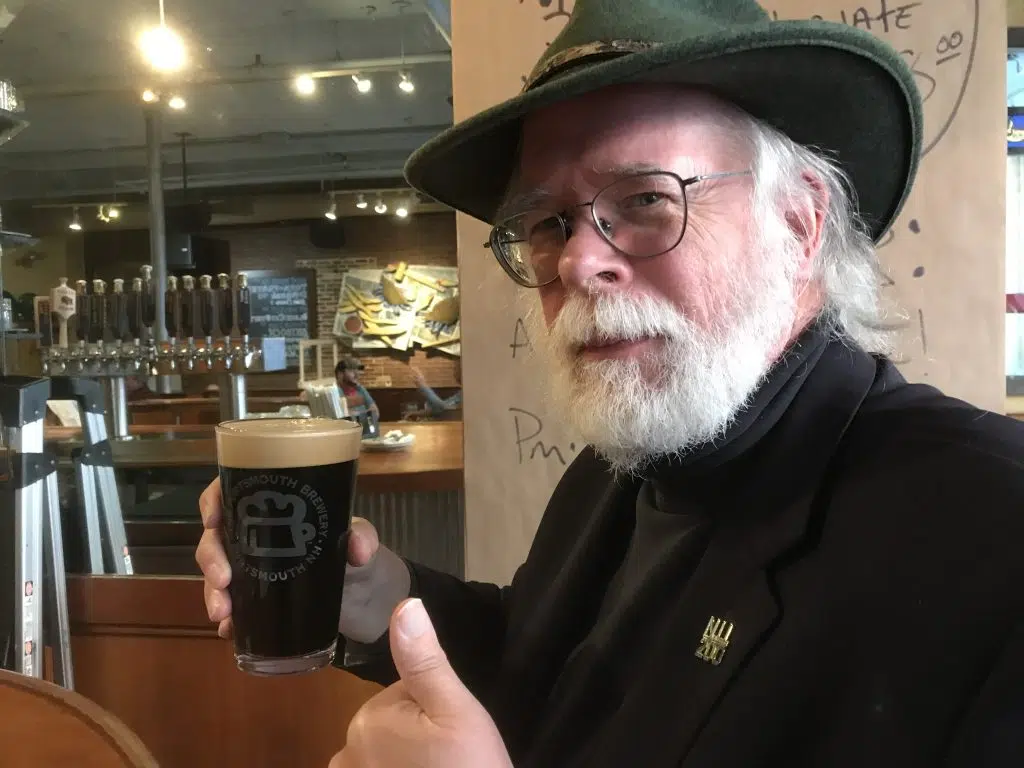
The participants were from left to right and then the narrator: “Lens”, “Tex” and “The Hat” as we began sampling “Sheep Eater” Scotch Ale from Grand Teton (remember what you learned in Spanish class now?) Brewing Company.

The beers that made it into notes and on camera were:

The “Sheep Eater” at a relatively easy going 7.5% abv and a fine malty-sweet flavor that neither overwhelmed the brew or got burned by the alcohol. The video is the only evidence I have that we tasted that one… and the empty bottle of course.


Next was the Widmer Brothers Barrel Aged “Brrrbon” Ale brewed as a Limited Release #3 Fall 2010 at 9.4% abv.


The consensus was that it lacked… well, it lacked the advertised intensity of either barrel or ale.
The third sample came via “Lens”… Ithaca Beer Company’s Excelsior! Brute Golden Sour Ale… and was opened with much anticipation as we were assured of its special flavor by the provider.


Here was the star of the show with the particular flavors of the Brettanomyces yeast used with the champaigne yeasts to finish the brew. At 7% abv it wasn’t a heavey hitter and didn’t claim to be. What it was, as I remember, was a refreshing sparkler that might scare some sippers but was the perfect brew for the three of us.
 
Until the next time…
Cheers!


Monday
Jan232012

A taste of... 5 O’Clock Shadow

Grand Teton Brewing Co. 430 Old Jackson Highway Victor, Idaho, 83455 United States phone: (208) 787-900Preface: This 12 oz. bottle of Grand Teton 5 O’ Clock Shadow was sent to me by the folks at Grand Teton Brewing Co. for inclusion in these tasting notes. This was a sample bottle so there was no date stamped on it.

The following notes are made after a mouth wash with room temperature sparkling water. These notes have not been influenced by reading promotional material or any other review of this brew.

The following are my tasting notes:

Appearance: A deep dark garnet red that is almost opaque. When I opened this bottle of beer there was no familiar gasp of CO2 escaping, however it poured with good carbonation that knit, as you can see, a thin light brown head of tiny bubbles.

Aroma: For the seasoned beer drinker, the first aroma is as familiar as the dark color of the beer, a complex mixture of chocolate, tobacco, caramel and leather. For those of you who are not familiar with the dark side of brewing, you’ll appreciate more of a prune aroma. A second visit reveals a slight hint of tar. The third nosedive combines all of the aromas mentioned before as the olfactory senses settle down and enjoy the sensation rather than trying to sorting them out.

Flavor: After the first refreshing sensation there is a complex mixture of chocolate and prune flavors that casts there vote with neither flavor but blends together. The second sip reveals a roasted grain flavor and echoes of the prune sensation in the aroma. The third swig and the olfactory and taste receptors have coordinated all the flavors and determined that is no fun at all to sort them out and have decided to simply enjoy the overall impression.

Mouth feel: This is a very full-bodied beer that leaves a lasting impression.

Finish: As noted above this is a long-lasting beer, however, the finish is neither thick nor obtrusive.

Comments: The good folks at Grand Teton have called this a “double black logger”. I can only assume that they did this to ensure the drinker is not expecting aromatics. The “double” designation seems to signify that this is a relatively high alcohol beer. Those familiar with brewing in the Republic of Ireland and in parts of Bavaria will immediately be drawn by the use of the words “black logger”. John Wayne asks for it in the motion picture “The Quiet Man”, and more than one Bavarian has asked for it when visiting a popular beer bar in Manhattan.

Food & Beer: This is a beer that would go quite well with a breakfast of fried ham and eggs, grits and sage sausage gravy, and the buttermilk biscuit slathered with butter and honey. I dare you!

The Brewery: Grand Teton  

What others say:

BeerAdvocate: N/A

RateBeer: N/A